In 30 seconds
- Fish to be eaten raw must be frozen at –20 °C for at least 24 hours or at –35 °C for at least 15 hours (Royal Decree 1021/2022, which repealed the old RD 1420/2006).
- You must tell customers that the fish has been frozen, for example on the menu or with a sign. There’s a documented exception for certain farmed fish.
- Sushi rice is controlled either by cooling and refrigerating it quickly or by acidifying it below pH 4.6, measuring and recording the pH.
- Key equipment: a freezer that reaches –20 °C with enough capacity, a walk-in cooler, a refrigerated prep table, a commercial rice cooker and a pH meter.
What you need to open a sushi restaurant
First, the same as any restaurant: an activity license or responsible declaration, registration with your region’s health registry, a HACCP plan, food hygiene training for your team and registration with the Spanish tax office and Social Security. You’ll find a summary in opening a restaurant in Spain: 10 things to keep in mind.
On top of that, the sushi-specific requirements:
- Freezing the fish you serve raw, to prevent anisakis.
- Telling customers that the fish has been frozen.
- Rice control: acidification or cold, with records.
- Separate areas and utensils for raw fish.
- Refrigeration equipment sized for your volume.
Anisakis: what current regulations say about raw fish
The rule that governs it today is Royal Decree 1021/2022, in force since December 22, 2022. It repealed Royal Decree 1420/2006, which many guides still cite. Its Article 8 requires establishments serving food to the end consumer to ensure that fish (except freshwater fish) and cephalopods served raw, marinated, pickled, salted or with any treatment insufficient to kill the larvae have been frozen, throughout the entire product, at:
| Temperature | Minimum time |
|---|---|
| –20 °C or lower | 24 hours |
| –35 °C or lower | 15 hours |
What matters for your day-to-day operations:
- You can freeze it yourself or buy fish already frozen by the supplier, as long as it’s backed by documentation. If you freeze it yourself, record dates, times and temperatures.
- Careful: the clock starts when the core of the piece reaches the temperature, not when you put it in the freezer. A domestic freezer, or a full one, may not get there in time.
- Marine aquaculture: it can be exempt from freezing if each batch comes with a declaration from the operator of origin certifying that the fish was raised from the embryo stage on a diet free of viable parasites. Without that declaration, it gets frozen.
- If the fish will be cooked to at least 60 °C at the core for one minute, it doesn’t need to be frozen.
The most forgotten obligation: telling the customer
The same article requires you to inform customers that these products have been frozen (or that they come from anisakis-free aquaculture), by whatever means you choose: for example, on the menu or with a sign. If you sell online, include it in your digital menu too.
Rice: acidified or chilled, but always controlled
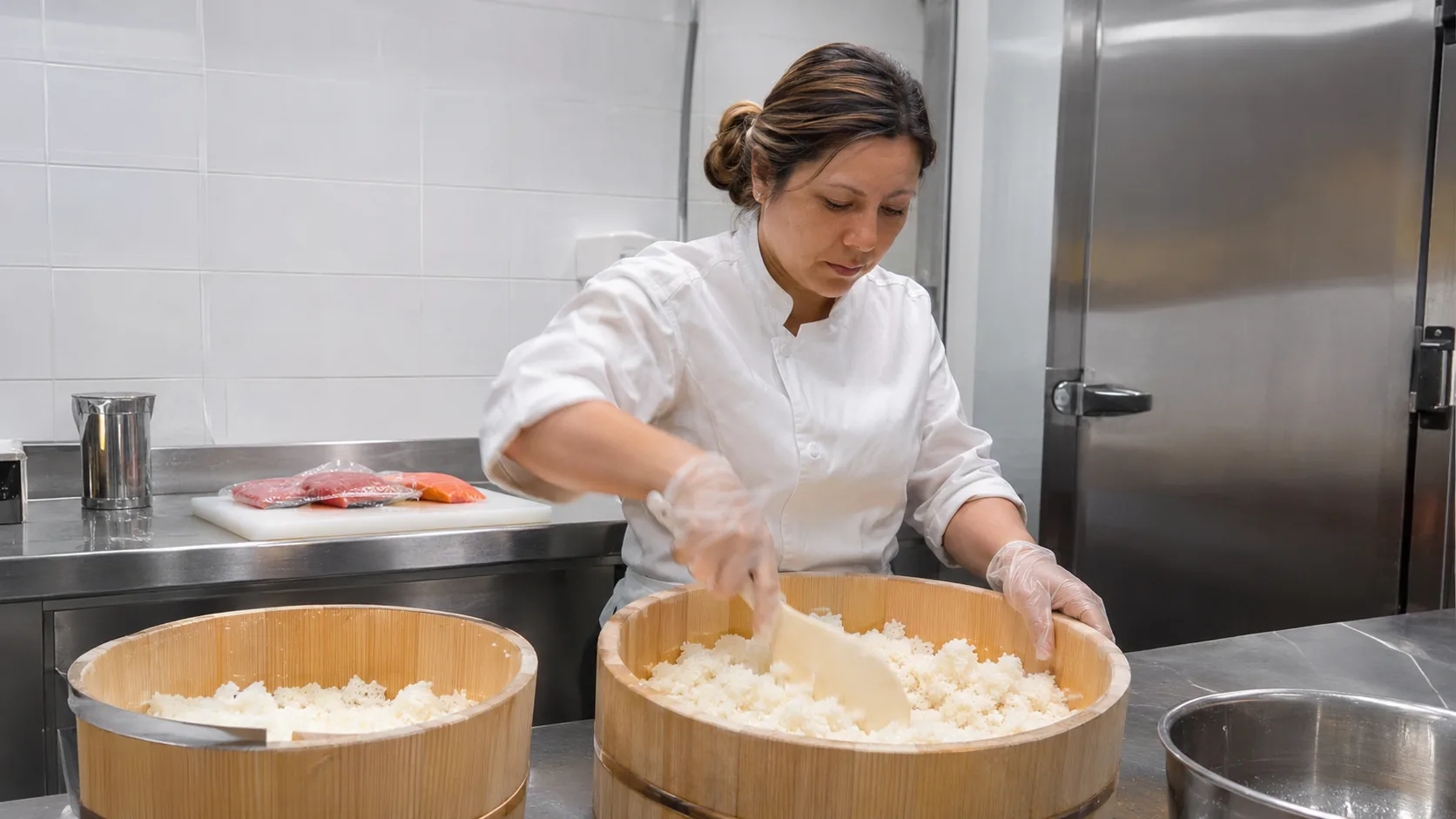
Cooked rice left at room temperature can cause food poisoning, mainly from Bacillus cereus. The recommendations of the Catalan Food Safety Agency set out two ways to control it:
- Acidify it with the rice vinegar mixture to a pH below 4.6 as soon as it’s cooked, mixing well so it reaches every grain, and checking and recording the pH with a meter. That way it can stay at room temperature for up to 4 hours until the sushi is finished, and the finished sushi for 2 more hours before serving; after that, at 8 °C or below.
- Without acidification, rice lasts at most 2 hours at room temperature, including prep time, and sushi made with it is served immediately or refrigerated.
Either way, make small batches and split them into portions so they cool quickly. These times are recommendations: what inspectors will require is that your HACCP plan defines how you control the rice and that you keep records.
Kitchen equipment for a sushi restaurant
| Equipment | What it’s for | What to check |
|---|---|---|
| Freezer or blast freezer | Freezing fish to be served raw. | That it reaches –20 °C (or –35 °C) at the core of the pieces with your real volume, and temperature logging. |
| Walk-in cooler or reach-in fridge | Thawed fish, prepared product and the day’s ingredients. | Stable temperature and room to keep raw apart from ready-to-eat. |
| Refrigerated prep table | Assembling pieces without breaking the cold chain. | A size that fits your assembly stations at peak hours. |
| Commercial rice cooker | Cooking rice in volume with consistent results. | Capacity for your peaks, not for an average day. |
| pH meter and probe thermometer | Checking the rice and temperatures. | Calibration and log sheets. |
| Dedicated knives and boards | Raw fish, kept separate from everything else. | Color coding and a dedicated work area. |
Before signing the lease, check that the electrical capacity can handle all your refrigeration running at once and that the layout allows a separate area for raw fish.
Allergens: sushi has a lot of them
Fish, crustaceans, mollusks, soy, sesame, gluten in some sauces, egg in certain mayonnaises. All of them must be listed on the menu and in your online store (Royal Decree 126/2015). Check the spec sheets for the sauces and ready-made products you buy.
Delivery: don’t let your margin go to commissions
Sushi travels well if the packaging keeps it cold and the pieces don’t move around, and it’s a product people order for delivery and takeaway. If a big share of your sales is going out that way, the cost of each channel matters. Delivery apps charge up to 30%, delivery included; having your own online store for repeat customers changes the margin on every order.
Where Delitbee fits in
Your online store with your brand and your menu (with the information you must give customers in each dish’s description), orders for now or for later, and direct orders straight into your POS. Delivery with your own riders or with external fleets. See Delitbee for sushi.
Frequently asked questions
Yes, sea fish and cephalopods served raw must have been frozen at –20 °C for 24 hours or at –35 °C for 15 hours (Royal Decree 1021/2022). You can freeze it yourself or buy it already frozen with supporting documentation. Salmon and other farmed fish can be exempt only with the declaration from the operator of origin.
No. It was repealed by Royal Decree 1021/2022, which since December 22, 2022 sets out the obligation to freeze fish for raw consumption and to inform the consumer.
You have to inform customers that the fish served raw has been frozen, or that it comes from anisakis-free aquaculture. The rule lets you choose how, for example on the menu or with a sign. If you sell online, include it there too.
The Catalan Food Safety Agency recommends acidifying it below pH 4.6, measuring and recording it. If you don’t acidify it, you have to control it through time and cold.
Sources
- Royal Decree 1021/2022 on hygiene requirements in retail trade · BOE · art. 8 (anisakis) and repealing provision (RD 1420/2006)
- Recommendations for the safe preparation of sushi · Catalan Food Safety Agency · Agència de Salut Pública de Catalunya and ASPB
- Sushi and food safety, recommendations · Higiene Ambiental · summary of the ACSA guide: pH 4.6 and rice holding times
- Royal Decree 126/2015 on food information for non-prepacked foods · BOE · allergens
Informational article, reviewed on Sep 27, 2026. The rice recommendations are for guidance only: your HACCP plan and your region’s health authority determine how you must control it. Confirm licenses with your city council and paperwork with your accountant or advisor.