In 30 seconds
- Every restaurant must let customers take home what they didn’t eat, at no extra cost, and say so visibly (ideally on the menu). All-you-can-eat buffets are exempt.
- Takeaway containers must be reusable or easily recyclable; if they’re single-use plastic, the rules of Law 7/2022 apply.
- The prevention plan is mandatory from April 2026, but not for micro-businesses or for premises of up to 1,300 m² (unless the group exceeds that in total).
- Fines range from up to €2,000 (minor) to €500,000 (very serious).
What Law 1/2025 is and when it applies
Law 1/2025 of April 1 on the prevention of food loss and waste was published in the BOE (Spain’s Official State Gazette) on April 2, 2025. It covers the entire food chain: producers, industry, retail and also hospitality.
The general obligations in Article 6 (prevention plan, donation agreements and order of priorities) have been enforceable since April 2026. So, as of today, the law is fully in force for restaurants.
The obligation that affects you most: leftovers to go
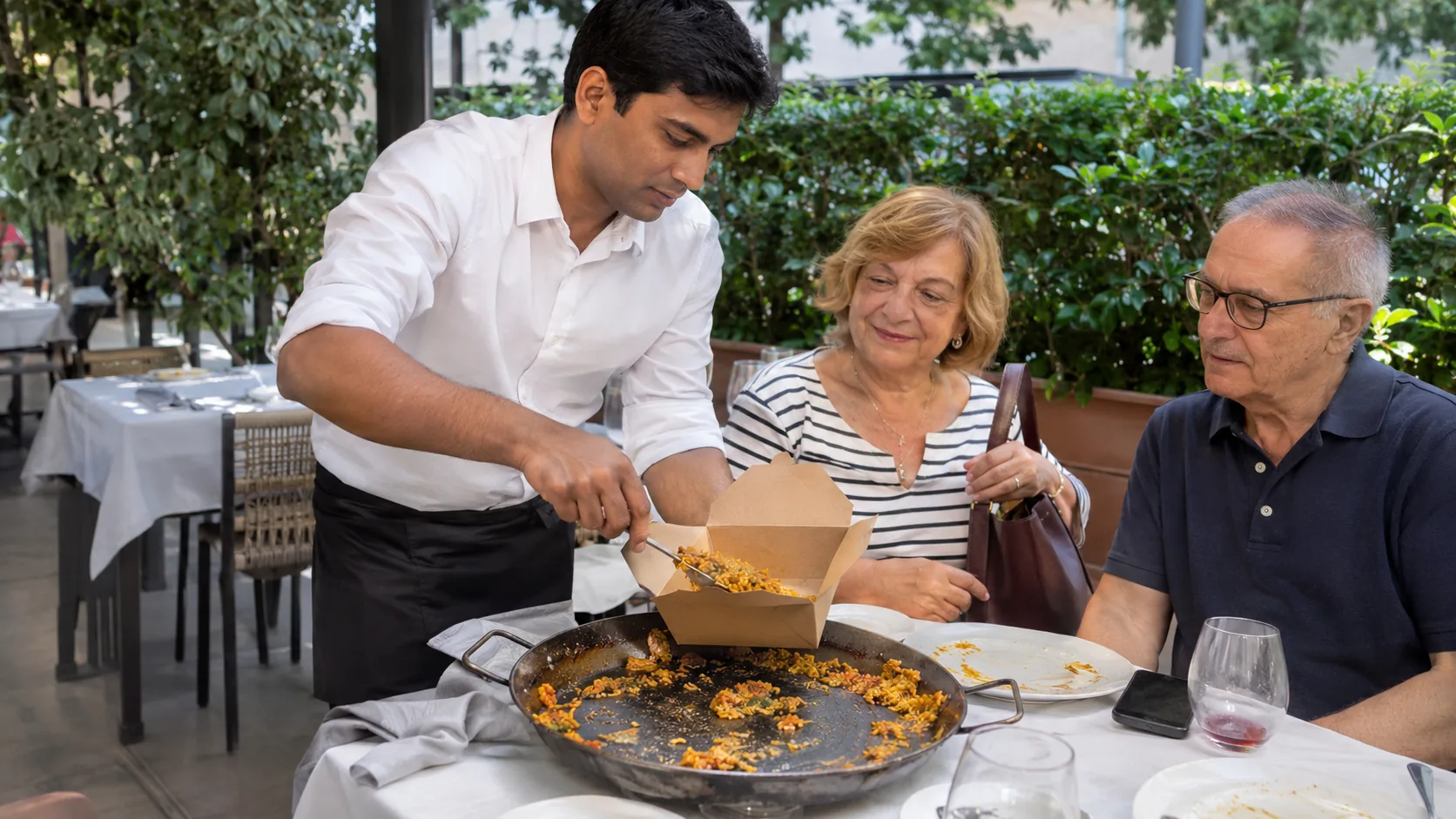
Article 8 is aimed directly at hospitality. If you run a bar or restaurant, you must:
- Make it easy for customers to take home what they didn’t eat, at no extra cost. It isn’t a favor: it’s the customer’s right.
- Use food-safe containers that are reusable or easily recyclable. If you use single-use plastic containers, they fall under Law 7/2022 on waste, which requires you to charge for them as a separate item on the receipt.
- Inform customers clearly and visibly on the premises, preferably on the menu.
The exception is all-you-can-eat buffets and similar formats where the amount of food isn’t limited.
How to comply in five minutes
Add a line to your menu (both the printed and the digital one): “If you have food left over, ask us for a container and take it with you.” Keep recyclable containers in the right sizes on hand and brief your front-of-house team. If you already have a QR menu, add it there too.
The prevention plan: who has to have one and who doesn’t
The law requires businesses in the food chain to have a food loss and waste prevention plan: a document explaining where food is wasted in your business and what measures you take to prevent it.
| Your situation | Prevention plan required? |
|---|---|
| Micro-business | No |
| Hospitality premises of up to 1,300 m² | No, unless your company has several establishments that together exceed 1,300 m² |
| Group or establishment above that threshold | Yes |
Even if you’re exempt, having a written plan helps: it forces you to look at your shrinkage and almost always saves money. For the practical side, see how to avoid stock losses.
The hierarchy: what to do with surplus food
The first step is to prevent it: buy and produce only what you need. If you still end up with surplus food fit for consumption, the law sets this order of priorities:
- Donation and other forms of redistribution for human consumption.
- Animal food and feed production.
- Use as a by-product in other industries.
- Recycling: compost, biogas or energy recovery.
Businesses covered by the law must also promote donation agreements with charities or food banks, and they can’t make food that is still fit for consumption unusable.
Penalties
The law sets out a three-level penalty system: minor infringements with fines of up to €2,000, serious ones from €2,001 to €60,000 and very serious ones from €60,001 to €500,000. Serious infringements include not having a prevention plan when one is required. Inspections are carried out by Spain’s regional governments.
How to reduce waste in your restaurant (and save money)
- A shorter menu with ingredients shared across dishes.
- Purchasing based on sales data by day and time slot, not by eye. With analytics you can see what sells and when.
- FIFO rotation in the walk-in and storeroom: first in, first out. We explain it in the FIFO method for restaurants.
- Right-sized portions and a half-portion option for the dishes that most often come back to the kitchen.
- Orders scheduled for later on your online store: knowing in advance what you’ll be preparing helps you produce just what you need.
Frequently asked questions
Yes. All bars and restaurants must make it easy for customers to take home what they didn’t eat at no extra cost, using reusable or easily recyclable containers, and must say so visibly. The exception is all-you-can-eat buffets.
The food waste law says “at no extra cost.” If the container is single-use plastic, Law 7/2022 on waste requires you to charge for it as a separate item on the receipt. If you’d rather not charge anything, use containers made of another recyclable material.
Not if you’re a micro-business or your premises are up to 1,300 m², unless your company has several establishments that together exceed that size. Above that, it has been mandatory since April 2026.
Up to €2,000 for minor infringements, from €2,001 to €60,000 for serious ones (for example, not having a plan when it’s required) and from €60,001 to €500,000 for very serious ones.
Sources
- Law 1/2025 of April 1 on the prevention of food loss and waste · BOE · Arts. 5, 6 and 8
- Law 1/2025 on the prevention of food loss and waste · COIAL · effective dates
- Law 1/2025 on food waste in hospitality · López Colmenarejo Abogados · penalty system
Informational article, reviewed as of the update date. For your specific case, check with your advisor.