In 30 seconds
- It’s a kitchen with no dining room that only sells for delivery and takeaway, often under several brands at once.
- You save on premises and front-of-house staff, but you live off the online channel: if everything comes in through aggregators, commissions (up to 30%, delivery included) eat your margin.
- There’s no national “dark kitchen license” in Spain: each city council fits it into its own zoning rules. Madrid, for example, caps their size in residential buildings.
- Profitability comes down to three things: well-defined brands, a short menu with shared ingredients and an own channel for repeat customers.
What a dark kitchen is (and what it isn’t)
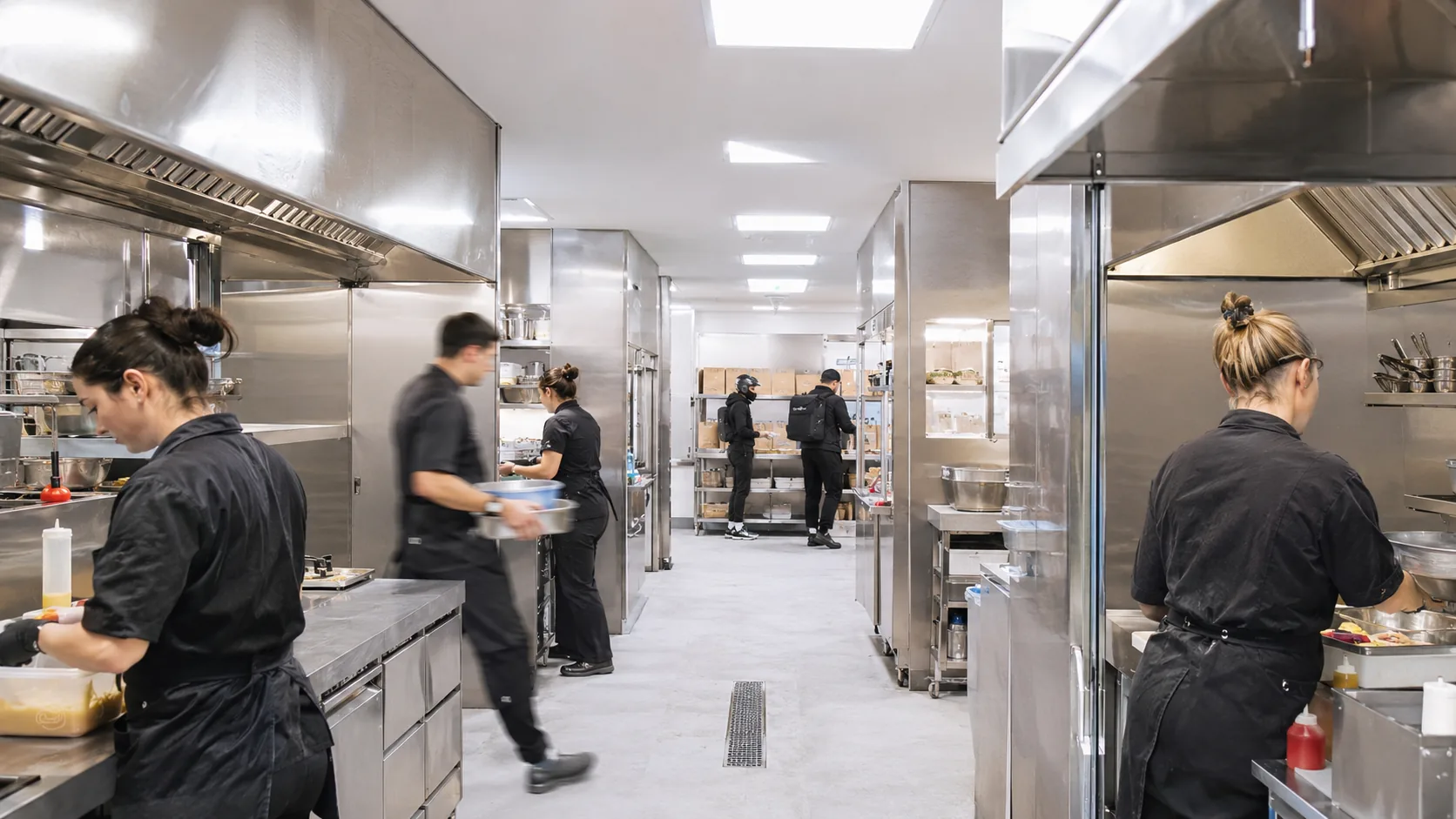
A dark kitchen, also called a ghost kitchen, virtual kitchen, cocina fantasma or cloud kitchen, is a professional kitchen built only to prepare delivery and pickup orders. It has no dining room and doesn’t serve anyone at a table: every order comes in online or by phone and leaves in a bag.
It’s worth separating three ideas that often get used as if they were the same:
- Dark kitchen: the physical place, the kitchen with no dining room.
- Virtual brand: a brand that only exists online. It can be cooked in a dark kitchen… or in a regular restaurant’s kitchen that makes use of its quiet hours.
- Aggregator: Glovo, Uber Eats or Just Eat. They’re storefronts that bring you orders in exchange for a commission; they don’t cook anything.
Where ghost kitchens come from
The model took off in the mid-2010s, driven by delivery apps. One of the most cited milestones is Deliveroo Editions: in April 2017 Deliveroo opened delivery-only kitchens in London and offered them to restaurants so they could reach neighborhoods where they had no location, choosing the area with its own demand data.
The 2020 pandemic made the model boom across Europe, Spain included. Then came the correction: many kitchens closed when demand settled back down, and the ones that survived had brands with pull, costs under control and customers who came back.
The 4 most common dark kitchen models
| Model | How it works | A good fit if… |
|---|---|---|
| One brand, own kitchen | Your kitchen, your brand, delivery and takeaway only. | You want to launch a concept with less investment than a restaurant with a dining room. |
| Multi-brand | Several virtual brands from the same kitchen, with the same team and part of the same stock. | You want to fill more time slots and show up in more searches on the apps. |
| Virtual brand inside a restaurant | Your sit-down restaurant adds one or more brands that only sell online. | Your kitchen has spare capacity and you don’t want to open another location. |
| Shared or rented kitchen | An operator rents out equipped kitchen spaces to several brands; you pay a fee and sometimes a percentage of sales. | You want to test a new area without any building work. |
Pros and cons, no sugarcoating
Pros
- Lower investment: no dining room, no décor, and premises on side streets or in cheaper warehouses.
- Launching and testing brands is fast.
- Everything is digital: you know what sells, when and where.
- A leaner team, focused on peak hours.
Cons
- No shop window and no foot traffic: you pay for visibility in commissions and promotions.
- Dependence on the apps and on their changes to commissions, delivery radius or algorithm.
- If customers order through the app, they’re the app’s customers: you don’t get their data.
- The food has to survive a 20-30 minute trip.
Licenses and requirements to open a dark kitchen in Spain
There’s no specific national license for dark kitchens. Each city council fits the activity into its zoning plan: some treat it as a restaurant, others as a food production workshop or something closer to industrial use. That’s why, before signing a lease, ask for a preliminary zoning compatibility check on that specific property.
What you’ll generally be asked for:
- An activity license or a responsible declaration (a self-certification filed with the council), depending on the municipality and floor area.
- A technical project: smoke extraction, ventilation, noise and odors, fire protection.
- Health registration: notification to your regional health authority (or entry in the general register if you also sell to other businesses), a HACCP self-monitoring plan and food handling training for your team.
- Liability insurance, plus registering the business and your team.
The Madrid case
After complaints from residents, the city council suspended new licenses for industrial kitchens in 2021 while it drafted the rules. The amendment to the city’s General Plan limits these kitchens in residential buildings to a maximum of 350 m² and requires loading, unloading and rider waiting to happen inside the premises, not on the street. In industrial parks the restrictions are lighter.
Where the margin is (and where it goes)
A dark kitchen’s costs fall into three buckets:
- Fixed: rent, equipment, licenses, utilities and core team.
- Product: ingredients and packaging. In food service, food cost usually runs between 25% and 35% of the price. A good recipe costing helps here.
- Channel: what you pay on each order depending on where it comes in. It’s the one that varies most and gets checked least.
Illustrative example · €25 order
Through an aggregator (30% commission, delivery included)€7.50
Through your online store with Delitbee (3% + €0.30)€1.05
The aggregator’s commission includes its delivery. On your own channel, delivery is separate and depends on whether you use your own riders or a fleet, and on the distance. Work out your numbers with the commission calculator.
It’s not about leaving the apps: at the start, they’re your shop window. It’s about getting customers who already know you to reorder through your own channel, where each order leaves you more margin and the customer is yours.
How to set up a dark kitchen, step by step
- Pick the area using data. Demand by cuisine, competition and a realistic delivery radius (many fleets work within a radius of just a few kilometers).
- Define your brands and a short menu. A few brands with a clear identity beat ten similar ones. Make them share ingredients and processes.
- Check zoning before you sign and budget for smoke extraction: it’s the line item with the most surprises.
- Design for the trip. Packaging that holds up, dishes that arrive in good shape and measured prep times. See how to cut prep and delivery times.
- Set up your channels. Aggregators to win customers and an online store of your own for each brand so customers reorder. With several brands, have every order come into a single screen.
- Decide how you deliver: your own riders, external fleets or a mix. Keep Spain’s Ley Rider in mind.
- Measure every week: average ticket, repeat rate, cost per channel and ratings.
The costliest mistake: all your customers belong to the app
A dark kitchen has no table where you get to know the customer. If every order comes in through aggregators, you don’t know who’s ordering and you can’t reach them again, and every repeat order pays the same commission as the first one.
What works: putting a reason to order direct next time in the bag (a card with a QR code and a first-order promotion), rewarding repeat customers with cashback and building customer loyalty without depending on Glovo or Uber Eats.
How we solve it at Delitbee
Each brand gets its own online store, and orders from all of them land in a single dashboard. You deliver with your own riders, external fleets or both from delivery management, without signing up with each fleet. See Delitbee for dark kitchens.
Frequently asked questions
Yes. Dark kitchen, ghost kitchen, virtual kitchen, cocina fantasma or cloud kitchen all refer to a kitchen with no dining room that only sells for delivery or pickup. What changes is the model: one brand, several brands or a shared kitchen.
It depends on your municipality. Each city council regulates it through its zoning rules, and some set limits on size and on loading and unloading (in Madrid, 350 m² maximum in residential buildings). Ask for a preliminary check before signing the lease.
Yes. It’s the same activity and the same health registration. What matters is operations: menus that share ingredients and orders from every brand coming into one system, so you’re not jumping from tablet to tablet.
It’s not mandatory, but at the start they help people discover you. Profitability comes when repeat customers order through your own channel, where you pay far less per order and the customer data is yours.
Sources
- Deliveroo · Wikipedia · launch of Editions in April 2017
- Madrid limits the size of ghost kitchens and requires them to load deliveries indoors · elDiario.es · Jul 29, 2021
- Madrid limits ghost kitchens: they can’t exceed 350 square meters · Madridiario
- Ghost kitchens stay in Madrid, but with limits and tighter oversight · El Debate · Nov 28, 2023
Informational article, reviewed as of the update date. License requirements vary by municipality: confirm them with your city council or a technical consultant before signing.