In 30 seconds
- A recipe costing sheet is the cost breakdown of a dish: ingredients per portion, waste and, for delivery, packaging.
- Always work with the net cost (after waste), not the purchase price per kilo.
- The channel moves your margin more than the recipe: a delivery app charges up to 30% with delivery included; your online store with Delitbee, 3% + €0.30 per order, with delivery charged separately.
- Update the costing sheet whenever a supplier or a price changes, and cross-check it against your best sellers.
What a recipe costing sheet is
A recipe costing sheet (in Spain, an “escandallo”) works out the cost of a dish from everything that goes into it: each ingredient, the exact amount per portion and what you lose when you clean or cook it. The Royal Spanish Academy (RAE) defines “escandallo” as “determining the cost or selling price of a good based on the factors that make it up.”
The costing sheet tells you three things: what each portion costs you, what share of the price goes on ingredients (your food cost) and how much is left to pay for the rest of the business. Without it, you price by eye and find out at the end of the month that your best-selling dish is the one that earns you the least.
In delivery the sheet gets longer. Every order goes out with a box, a bag, single-serve sauces and napkins. And every channel charges differently: an order that comes in through an app is not the same as one that comes in through your website.
How to cost a recipe step by step
1. Write down the ingredients and the weight of one portion
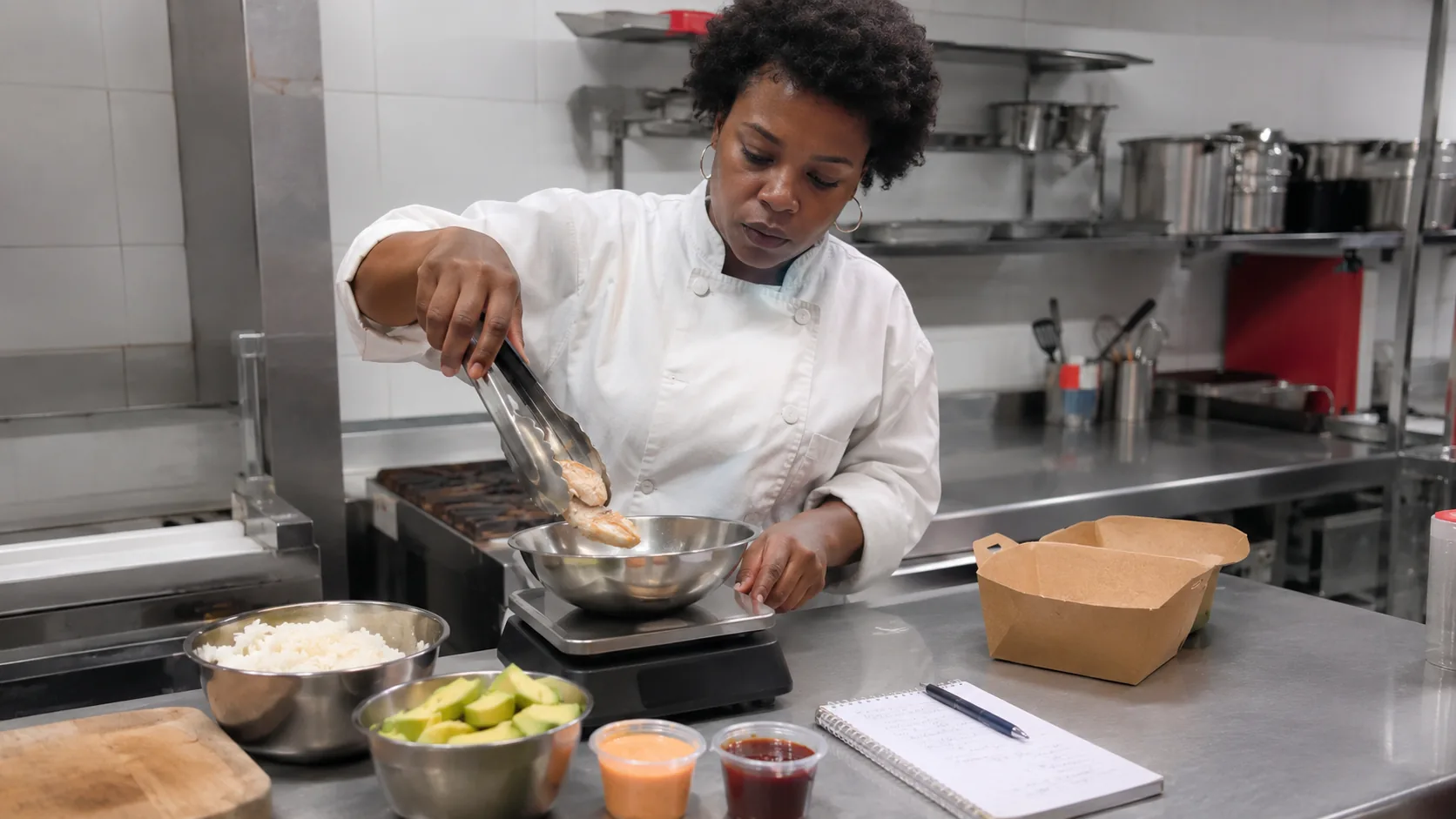
Weigh it, don’t guess. Make the dish exactly as it’s served and note each ingredient with its amount: grams of meat, slices of cheese, grams of sauce. If every cook uses a different amount, the costing sheet is useless: set the portion and put it in writing (and in a photo) in the kitchen.
2. Use the real purchase price
Take the price from each supplier’s latest invoice, or an average of recent purchases if the price goes up and down. Always work without VAT and in the same unit (euros per kilo, per liter or per unit).
3. Apply waste: from gross price to net cost
Not everything you buy ends up on the plate. Lettuce gets trimmed, fish gets filleted, meat loses weight on the griddle. That’s why you calculate the yield: how much of the product you buy is actually usable. Measure it yourself, because it depends on the supplier, the cut and the way you work.
Illustrative example · lettuce waste
Purchase price€2.00/kg
Yield measured after trimming (750 g usable per kilo)75%
Net cost: €2.00 ÷ 0.75€2.67/kg
Made-up figures to show the calculation. With the net cost, every gram you put on the plate already includes what you threw away when trimming.
4. Add the packaging
In delivery the packaging is part of the dish: box or tray, lid, bag, sauces, cutlery, napkins and a seal sticker. Work it out per dish (the box) and per order (the bag) or, more simply, divide what you spend on packaging each month by the month’s orders.
Watch out for single-use plastic: since January 1, 2023, Spain’s Law 7/2022 requires you to charge separately for single-use plastic cups and containers for ready-to-eat food, shown as a separate line on the receipt, and the sale of single-use plastic cutlery is restricted. Cardboard, paper or reusable containers spare you that charge and usually look better too.
5. Work out the cost per portion and the food cost
| Illustrative example · burger | Quantity | Cost |
|---|---|---|
| Bun | 1 unit | €0.35 |
| Beef (€9/kg net) | 150 g | €1.35 |
| Cheese | 2 slices | €0.25 |
| Vegetables (net cost) | 60 g | €0.20 |
| Sauce | 20 g | €0.10 |
| Ingredient cost | — | €2.25 |
| Packaging (box plus a share of the bag and napkins) | — | €0.55 |
| Total cost of the dish | — | €2.80 |
If you sell this burger for €10 without VAT, the food cost is 2.25 ÷ 10 = 0.225: almost 23%, and 28% with packaging. There’s no single “right” percentage for everyone: it depends on your concept, your rent and your team. What matters is knowing it dish by dish and making sure it doesn’t shift without you noticing.
Channel cost: what moves your margin the most
The same dish leaves a different margin depending on where the order comes in. That’s why, in delivery, the costing sheet needs one more line at the end: the channel cost.
- Delivery apps (Glovo, Uber Eats, Just Eat): they charge a percentage of the order that can reach 30% with delivery included. It’s a variable cost: the more you sell, the more you pay.
- Your own online store: with Delitbee you pay 3% + €0.30 per order. Delivery is separate: you handle it with your own riders or an external fleet, and its price depends on distance and the fleet. You can charge the customer part of the delivery fee.
- In-store pickup: no delivery; just the payment processing cost.
Illustrative example · order of 2 burgers (€20 without VAT)
Cost of both dishes with packaging€5.60
Through a delivery app: 30% commission, delivery included€6.00
What you keep through the app€8.40
Through your online store: 3% + €0.30€0.90
Fleet delivery: €7 paid by the restaurant, €3 paid by the customer€4.00
What you keep through your own channel€9.50
Made-up, rounded figures. Real commissions depend on your contract, and delivery costs on distance and the fleet. Work out your own numbers with the commission calculator.
How to set the price on each channel
With the cost of the dish and the cost of the channel, you can now work out a minimum price: the one that covers your cost and leaves the margin you need.
Minimum price = cost of the dish ÷ (1 − % the channel charges − % margin you want)
With the burger from the example (€2.80) and a target margin of 45% of the price, on a delivery app at 30% the minimum price would be 2.80 ÷ (1 − 0.30 − 0.45) = €11.20 without VAT. On your own channel the commission is much lower, so that same price leaves you a much bigger margin, although you have to add what delivering each order costs you.
Many restaurants have different prices on the apps and on their website. If you do, check what your contract with each platform says first. And if you have a different menu per channel, organize it with care: we explain how in how to organize your delivery menu.
Mistakes that make your costing sheet useless
- Doing it once and forgetting about it. Review it when a supplier changes, an ingredient goes up or you change the recipe.
- Leaving out waste or packaging. A dish can look profitable at the price per kilo and stop being so once you factor in the net cost and the box.
- Portions that change depending on who’s cooking. Set the weight and check it every now and then.
- Not cross-checking it against sales. One low-margin dish that sells a lot weighs more than ten that hardly ever go out. Look at your product ranking and start there; if you also want to raise the value of each order, read how to design a combo that leaves a margin.
- Ignoring what gets thrown away. Waste that isn’t in the recipe (expired product, leftover prep) is a cost too. We cover it in how to avoid stock losses.
Where Delitbee fits in
Delitbee doesn’t build costing sheets, but it does help you with the other two numbers: on your online store you pay 3% + €0.30 per order, and analytics gives you your product ranking and a report comparing your own store with the platforms. That way you know which dishes to push and which channel pays off best.
Frequently asked questions
The costing sheet lists the cost of every ingredient in a dish. Food cost is the result expressed as a percentage: ingredient cost divided by the selling price without VAT.
Whenever something that affects it changes: a supplier, a purchase price, the recipe or the packaging. At the very least, review your best sellers and the dishes with the most expensive ingredients every now and then.
Not in the dish’s costing sheet: that’s for ingredients and packaging. But to set the selling price on each channel you do need to add what that channel charges you per order, because it changes your margin a lot.
Many restaurants do it to make up for the commission. Before you do, check the terms of your contract with each platform.
Sources
- Escandallo · Dictionary of the Spanish Language (RAE) · sense 4
- Law 7/2022 on waste and contaminated soils for a circular economy · BOE · art. 55 and annex IV: charging for single-use plastic cups and containers
Informational article, reviewed on September 27, 2026. The examples are illustrative. For how VAT and packaging should appear on your receipts, check with your accountant or advisor.